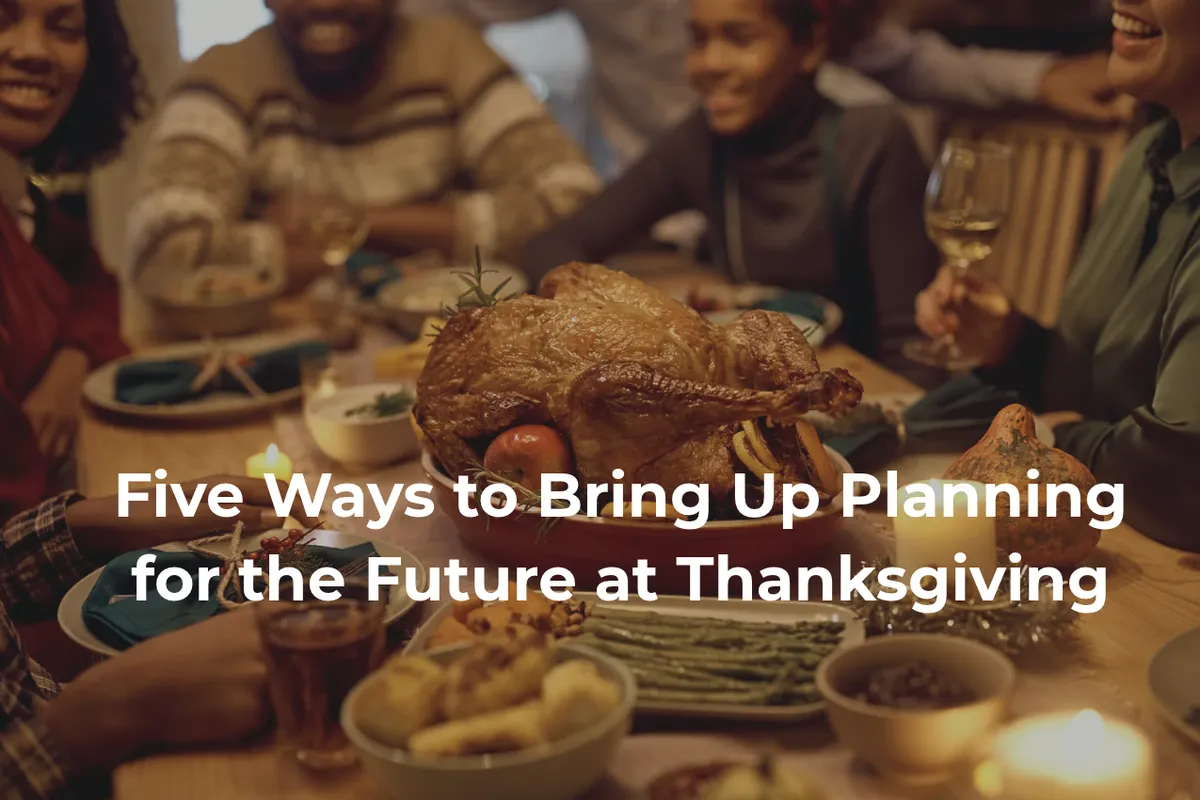
Five Ways to Bring Up Planning for the Future this Thanksgiving
Is this your family too?
The conversation that almost happens every year. Someone mentions mom’s upcoming surgery, or the house that's getting to be too much, or the cousin whose father died without a will. The table goes quiet for a second. Then someone asks who wants more stuffing, and the moment passes.
Then it's another year. Another missed opportunity to ensure the people you love most have a solid plan in place for “what happens when….”
If you've been meaning to talk to your family about estate planning,Thanksgiving is one of the best chances you'll get. Here's how to start that conversation without turning your family dinner into an uncomfortable silence.
Why the Thanksgiving holiday works
The people you need are already in one room. Nobody has to schedule a Zoom or drive across the county. Your parents are there, your siblings are there, and for once nobody is rushing off. Plus, you’re all happy to be together (hopefully).
Last Thanksgiving, I asked my mother-in-law about her own plan. She said she thought she had it all covered and I left it at that. A week later when the two of us took a second look at her documents, which were started five years prior, nothing had been signed or notarized. Her “estate plan” was a set of draft documents and unfunded accounts. By Christmas we had an actual plan in place.
How to start: lead with gratitude
Thanksgiving is a time to be grateful for family. You can show you care by saying that out loud first, then explaining why you want to talk. Try something like:
"I'm really grateful we're all here. It got me thinking about how much I want to take care of this family and to be prepared no matter what happens, and I'd like us to be on the same page about the future. Can we talk for a few minutes after dessert?"
Gratitude first, then the reason, then one small, specific ask. Nobody feels ambushed, and everyone knows the conversation is coming.
What should you actually talk about?
You don't need to cover everything. A first conversation can stay on three questions:
Who would make decisions if you couldn't? For medical care and for money.
Where are the important papers? (Or are the important things handled?) The will or trust, insurance policies, account logins, the deed.
What matters most to you? The house, the kids, a family business, how you want to be cared for.
An estate plan, in plain English, is the set of documents that answers those questions in writing, so your family doesn't have to guess. Talking first makes the documents easier to get right.
Five ways to start the conversation
Pick your moment. Not while the turkey is coming out of the oven. Not in front of the in-laws you barely know. After pie, before the dishes, when things are slow and the right people are nearby. Ten quiet minutes is plenty.
Start with a story. Facts and percentages make people defensive. A story makes them curious. "Remember how long it took to sort out Grandpa's house? I don't want that for any of us." That opens the door without pointing a finger at anyone.
Go first. Share what you've done, or what you're about to do. "I just named a guardian for the kids, and it made me wonder whether you two have anything in place." Going first turns it into an invitation.
Ask one question. Then listen. Pick one question and let the answer be whatever it is. "If something happened to you, who would you want making decisions?" Resist the urge to fix, correct, or plan on the spot. People talk more when they don't feel managed.
Aim for a second conversation. You won't settle everything at the table, and you shouldn't try. Count it as a win if you leave with a date on the calendar to keep talking.
What if it goes sideways?
Sometimes it will. Someone gets defensive. An old issue between siblings rears its head again. That's normal, and it doesn't mean you failed.
A few things I use at the mediation table work at the dinner table too. Name what's happening, kindly: "I can tell this is uncomfortable. It is for me too." Take a break if you need one. And keep coming back to the reason you brought it up in the first place, which is that you care about each other.
After Thanksgiving: turn the talk into a plan
A good conversation is the first step. The next step is working with an attorney who gets to know your family and creates legal documents and a complete plan that will actually work when your family needs it, including keeping the plan updated as life and the law changes.
Not sure where your family stands? Take my free Family Protection Scorecard together. It's just a few questions and takes 3 minutes, and you'll see where the gaps are. Pass the phone across the table after pie, or send the link to your parents before Thursday.
If the results raise more questions than answers, that's the work I do with families across the Santa Ynez Valley, Santa Barbara and California. Complete Your Family Protection Scorecard: https://planwithtamara.com/estate-planning-quiz