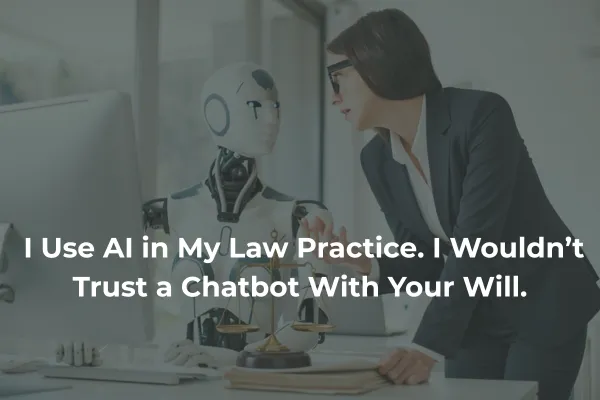
Can AI Write Your Will or Trust? What a Chatbot Misses About Your Family
Type "create a will for me" into an AI chatbot and ten seconds later you'll have a document. It has a title, numbered articles, and the word "hereby" in all the right places. It may even use your children's names.
I spent 10 years in litigation and 13 years as a family conflict mediator, and I've seen this pattern again and again: a document that looked fine for years gets tested at the worst possible time, by people who are grieving and had no part in writing it.
So sure, an AI-generated will might let you check "finish estate plan" off your mental to-do list. The mistakes won't show up until later, when you can no longer fix them and your family is left to deal with them.
I love technology, and I use AI in my own practice. That's how I know where a chatbot falls short and what it takes to use AI well for legal work that won't fail.
Can AI write a valid will or trust in California?
AI can write a document that looks like a will or trust. Whether it works under California law and whether it will do what you intended are two different questions, and nobody checks until the person who signed it has died or lost capacity.
Start with the signing. Execution requirements are the specific rules for how a document must be signed and witnessed before a court will enforce it. In California, a will generally needs two witnesses who watched you sign. A missing witness, the wrong witness, or a signing nobody documented can cause serious problems, and a chatbot cannot stand in the room and see who showed up. Signing is only one place a plan can fail without a licensed attorney guiding you through the process. Imagine what other pitfalls there are along the way that an attorney does second nature?
What does a chatbot get wrong about state law?
Estate planning rules change from state to state, and an AI tool trained on general information can blend them together. California is one of nine community property states, which changes who owns what the moment you marry. A plan built on another state's assumptions can misstate your ownership before it reaches page two.
Some chatbots also make things up. They produce legal terms, rules, and even statutes that do not exist, in the same confident tone as the real ones. Someone who is not a lawyer has no way to tell the difference. The document looks professional, which is exactly why the mistakes get past you.
What does an estate planning attorney ask that AI can't?
When a client tells me their youngest should be the backup trustee, I ask why that child. I ask whether the other children will understand. I ask whether anyone pushed for the change, and whether an outright inheritance would protect a beneficiary or put them at risk. Then I pay attention to the pause before the answer.
A chatbot responds to what you type. It cannot hear hesitation, notice tension between siblings, or catch the detail that does not fit. In 13 years at the mediation table, the most important fact in the room was usually the one nobody had written down.
Where do estate plans actually fail?
Often after the signing. A trust only controls what is titled in its name. In California, assets left in your own name above the small-estate limit (currently $208,850) can still end up in probate, the slow, public, expensive process the trust was supposed to avoid. A beneficiary form on a retirement account or life insurance policy overrides your will, so an old form that still names an ex-spouse can send the money to the ex-spouse.
A chatbot generates a document. It does not look at your deed, your accounts, or your beneficiary forms, and a plan only works when all of them agree with each other.
Is a chatbot conversation confidential?
Generally, no. What you tell an attorney is protected by confidentiality duties and, in most cases, attorney-client privilege. What you type into a public AI tool generally is not, and the company that runs the tool may store it. Estate planning conversations include things like unequal inheritances, a child who struggles with money or addiction, and the decision to disinherit someone. Those are details to think twice about before typing them into any public tool.
Do I use AI in my own practice?
Yes, I absolutely do. I believe technology, used correctly, sharpens my expertise and helps me serve my clients better and more cost-effectively. The difference is in the tool and in who is holding it. The AI I use is built for attorneys and comes with proper privacy safeguards. I'm also a seasoned attorney, so I can make sure it assists my professional knowledge, judgment, and common sense and never replaces them.
A trust I draft with attorney-only AI technology will look very different from a trust a non-attorney puts together with a consumer tool. Those consumer tools typically carry a disclaimer that they cannot give legal advice, and they are right to, because legal advice takes a licensed attorney.
How should you use AI for estate planning?
Use it to prepare, because it is good at that. Ask it to help you list your accounts, write down who you would want as guardian and why, and put your worries into words. Then bring that list to a conversation with a person who is licensed in California and who will ask the follow-up questions.
If you have already started a plan with a chatbot, a template, or a form from the internet, I'd like to see it. At Truce Resolutions in Solvang, I work with families across the Santa Ynez Valley, Santa Barbara, and San Luis Obispo. Book a complimentary 15-minute Kickstart Call and bring whatever you have so far, including anything a chatbot wrote: Schedule a Kickstart Call
This article is for educational purposes only and is not legal, tax, or financial advice. For advice about your situation, schedule a consultation.